Your Health Fund, Your Gut, Your Hormones: What the Naturopathy Rebate Means for You in 2026
Australia has legislated the reinstatement of private health insurance rebates for naturopathy. For the millions of women navigating perimenopause, many of whom have been managing gut symptoms and hormonal changes with natural therapies at full cost, this is a significant shift. Here is what it means for you, and what to do next.

Women's Health · Policy Update · 2026
Your Hormones, your gut, your health:
What the Naturopathy Rebate Means for You in 2026
Evidence-based · 25 peer-reviewed references · 15 min readThe Short Version
From 1 July 2025, the Australian Government legislated naturopathy back into private health insurance eligibility. Individual health funds are still finalising implementation, including provider numbers and item codes, but announcements are expected imminently. If you have been managing gut symptoms or hormonal changes with natural therapies during perimenopause, this change could meaningfully reduce your out-of-pocket costs.
Why This Matters Specifically for Menopausal Women
If you have been managing bloating, constipation, acid reflux, or unpredictable digestion alongside hot flushes, mood changes, or disrupted sleep, you are not imagining a connection. The gut-menopause link is well-established in the research, and it is one of the most underserved areas of women's health.
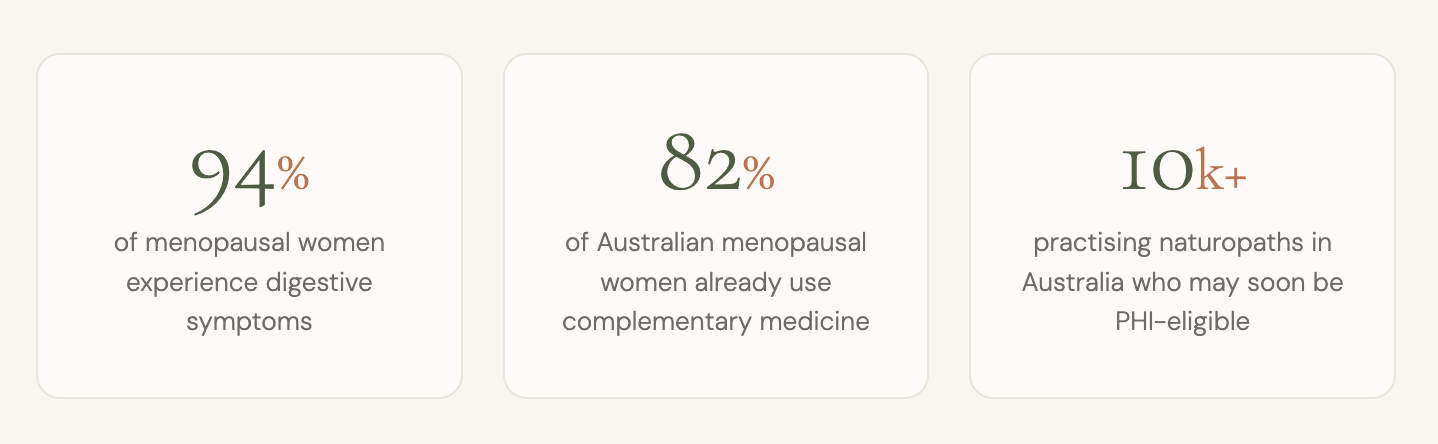
A landmark 2025 study of nearly 600 perimenopausal and menopausal women found that 94% experienced digestive symptoms, and in 82% of cases, those symptoms began or worsened specifically at perimenopause or menopause. Yet most conventional GP appointments are not long enough to address the complexity of what is happening hormonally, nutritionally, and in the gut simultaneously.
This is precisely the territory where a skilled naturopath adds enormous value, and precisely why the reinstatement of PHI rebates for naturopathy is such significant news for women at this life stage.
What Has Actually Changed, and What Has Not Yet
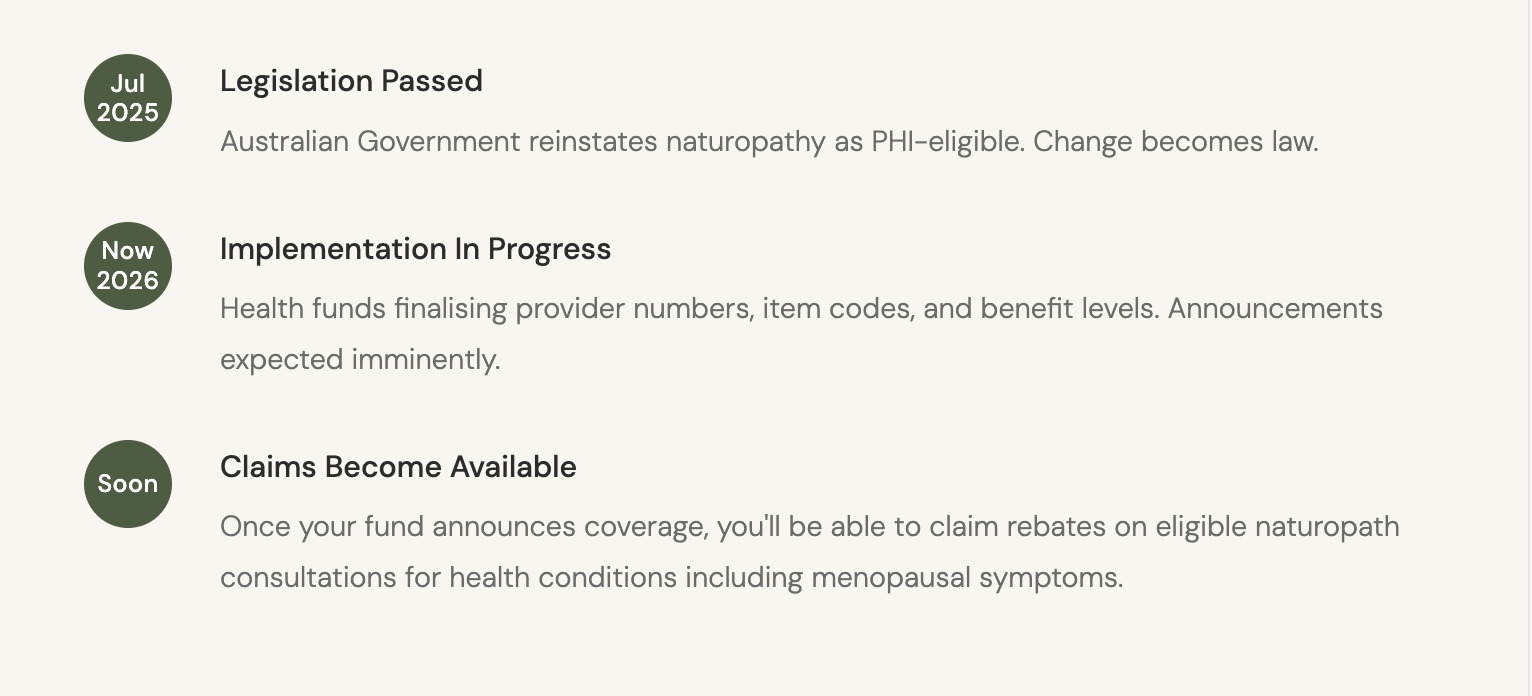
It's important to understand that this is a two-stage change, and we are currently between those stages.
What has happened
The Australian Government amended private health insurance legislation, effective 1 July 2025, to reinstate naturopathy and western herbal medicine as eligible therapies for PHI rebates. This is a legislative reality: the policy gate is open.
What is still in progress
Each individual private health insurer must independently decide whether to offer coverage, at what level of benefit, and under what conditions. Provider numbers for naturopaths have not yet been issued, and major health funds have not yet made formal announcements. This is the stage we are in right now, in early 2026. Announcements are expected imminently.
What Types of Menopausal Conditions Will Be Covered?
While each fund will set its own terms, the legislation specifies that rebates apply to treatment of health conditions, not general wellness or lifestyle support. This framing actually works in your favour, because the symptoms you are managing are clinical health conditions, not lifestyle preferences.
Conditions that are likely to qualify for rebate-eligible naturopathic care include:
Digestive complaints including bloating, IBS-type symptoms, constipation, and acid reflux with menopausal onset or worsening
Vasomotor symptoms (hot flushes, night sweats) managed through herbal and nutritional protocols
Sleep disruption and fatigue associated with perimenopause
Mood changes, anxiety, and cognitive symptoms during hormonal transition
Bone density support and cardiovascular risk management in postmenopause
Hormonal balance programs incorporating nutritional medicine and western herbal medicine
Why the Gut-Menopause Connection Makes Naturopathic Care Particularly Valuable
Conventional medicine tends to silo these two things: a GP might prescribe HRT for hormonal symptoms, and refer you to a gastroenterologist for gut complaints. But the research tells us they are deeply connected, and addressing one without the other leaves results on the table.
Oestrogen and progesterone receptors exist throughout the gastrointestinal tract. As these hormones decline during perimenopause, gut motility slows, the composition of the gut microbiome shifts, and the gut-brain axis becomes more reactive. A 2025 review in Nature Reviews Gastroenterology and Hepatology confirmed that menopausal status directly alters gut function, and that women with pre-existing digestive conditions experience significantly worse menopausal symptoms overall.
A naturopath working with you on this transition is not just addressing hot flushes. They are looking at your whole hormonal ecosystem, including the gut, the liver (which processes oestrogen), the nervous system, and your nutritional status. That integrated approach is precisely what the research says this life stage requires, and what PHI coverage will soon help fund.

Just the tip of the iceberg - in fact, every process in every cell is impacted in some way by circadian signalling.
What to Do Right Now
Check your current policy. Log into your health fund's app or website and look at what extras your policy includes. Note whether natural therapies are listed, as this will give you an indication of how quickly your fund is likely to move.
Watch for your fund's announcement. Major announcements are expected imminently. Most funds will communicate via email and app notification, so make sure your contact details are current.
Find an accredited naturopath now. Search for a naturopath registered with ANTA (Australian Natural Therapists Association) or NHAA (Naturopaths and Herbalists Association of Australia), as these are the accreditation bodies funds are working with to establish provider eligibility.
Document your symptoms before your first appointment. A symptom diary covering digestive complaints, hormonal symptoms, sleep, mood, and energy gives your naturopath a much richer starting point and makes your care more efficient. Even two weeks of notes is valuable.
Ask about health management programs. The legislation specifically references coverage for health management programs. Structured programs that combine consultation with education and monitoring may attract higher rebate levels than standalone appointments.
What to Do Right Now
Check your current policy. Log into your health fund's app or website and look at what extras your policy includes. Note whether natural therapies are listed, as this will give you an indication of how quickly your fund is likely to move.
Watch for your fund's announcement. Major announcements are expected imminently. Most funds will communicate via email and app notification, so make sure your contact details are current.
Find an accredited naturopath now. Search for a naturopath registered with ANTA (Australian Natural Therapists Association) or NHAA (Naturopaths and Herbalists Association of Australia), as these are the accreditation bodies funds are working with to establish provider eligibility.
Document your symptoms before your first appointment. A symptom diary covering digestive complaints, hormonal symptoms, sleep, mood, and energy gives your naturopath a much richer starting point and makes your care more efficient. Even two weeks of notes is valuable.
Ask about health management programs. Talk to your Health Insurance Provider and tell them what you most value. The legislation specifically references coverage for health management programs. Structured programs that combine consultation with education and monitoring may attract higher rebate levels than standalone appointments.
Frequently asked questions -
-
Yes. The Australian Government legislated the reinstatement of PHI rebates for naturopathy and western herbal medicine from 1 July 2025. Individual health funds are now working through implementation, including establishing provider numbers and item codes. Announcements from major insurers are expected imminently in early 2026.
-
Not yet, but soon. The legislative change is in place, but the practical machinery (provider numbers for naturopaths, fund-specific item codes) is still being finalised as of March 2026. Check directly with your insurer for the latest on when claims will be available under your policy.
-
Once fully implemented, PHI rebates for naturopathy will apply to the treatment of health conditions, which includes symptoms such as digestive complaints, bloating, hormonal imbalance, hot flushes, sleep disruption, and mood changes during perimenopause and menopause. Gut health in this hormonal transition is one of the most directly relevant applications of the new coverage.
-
Research published in 2025 found that 94% of perimenopausal and menopausal women experience digestive symptoms. The most common are bloating (77%), constipation (54%), stomach pain (50%), and acid reflux (49%). In 82% of cases, symptoms began or worsened specifically at perimenopause or menopause, pointing to a direct hormonal connection to gut function.
-
Evidence-informed natural approaches for menopausal gut symptoms include ‘specific’ targeted probiotic strains, digestive enzymes, phytoestrogen-rich herbs (such as red clover and black cohosh), anti-inflammatory dietary protocols, and gut-supportive nutrients including magnesium, zinc, and glutamine. A naturopath tailors these to your individual symptom profile, health history, and any medications you're taking to ensure they don’t alter how your medication works.
-
Oestrogen and progesterone receptors are present throughout the gastrointestinal tract. As these hormones decline during perimenopause and menopause, gut motility changes, the gut microbiome shifts, and the gut-brain axis becomes more sensitive. This is why bloating, constipation, and digestive discomfort so often emerge or worsen during this life stage, and why an integrated approach to hormonal and gut health produces better outcomes than treating each in isolation.
-
Health funds are working with ANTA (Australian Natural Therapists Association) and NHAA (Naturopaths & Herbalists Association of Australia) to establish practitioner eligibility. When searching for a naturopath ahead of fund announcements, prioritise practitioners registered with one of these bodies to ensure they're likely to be PHI-eligible when claims open.
A note on accuracy: This article reflects the legislative and implementation status of private health insurance naturopathy reinstatement as of March 2026. PHI policy details change rapidly. Always confirm current coverage directly with your health fund. This content is educational and does not constitute medical advice. Please consult a qualified healthcare practitioner for personalised guidance on managing symptoms during perimenopause and menopause.
References:
Australian Government Department of Health, Disability and Ageing. (2025, June 20).PHI 51/25: Private Health Insurance Legislation Amendment Rules (No. 5) 2025. Australian Government.https://www.health.gov.au/news/phi-circulars/phi-5125-private-health-insurance-legislation-amendment-rules-no-5-2025
Australian Government Department of Health, Disability and Ageing. (2025, December 3).PHI 98/25: Eligibility of services for private health insurance general treatment benefits where they include elements of excluded natural therapies. Australian Government.https://www.health.gov.au/news/phi-circulars/phi-9825-eligibility-of-services-for-private-health-insurance-general-treatment-benefits-where-they-include-elements-of-excluded-natural-therapies
Naturopaths and Herbalists Association of Australia. (2025, July 30).Private health insurance rebates are returning: What this means for NHAA practitioners. NHAA.https://nhaa.org.au/news/private-health-insurance-rebates-are-returning-what-this-means-for-nhaa-practitioners/
Australian Traditional Medicine Society. (2025, July 3).Member update: Natural therapies reinstated for private health insurance rebates from 1 July 2025. ATMS.https://www.atms.com.au/member-update-natural-therapies-reinstated-for-private-health-insurance-rebates-from-1-july-2025/
Australian Natural Therapists Association. (2025, April 16).Seven natural therapies return to private health insurance. ANTA.https://www.australiannaturaltherapistsassociation.com.au/blog/seven-natural-therapies-return-to-private-health-insurance/
Southern Cross University. (2025).Private health insurance rebates restored for natural therapies. SCU News.https://www.scu.edu.au/news/2025/private-health-insurance-rebates-restored-for-natural-therapies/
Denby, N. (2025, October 21).Menopause and the gut: Uncovering a hidden health burden[Poster presentation]. 2025 Annual Meeting of The Menopause Society, Orlando, FL, United States.
The Menopause Society. (2025, October 21).Digestive health issues more common during perimenopause and menopause[Press release].https://menopause.org/press-releases/digestive-health-issues-more-common-during-perimenopause-and-menopause
Faubion, S. S. (2025, October 21). Commentary on digestive health burden in menopausal women. Cited in: The Menopause Society.Digestive health issues more common during perimenopause and menopause[Press release].https://menopause.org/press-releases/digestive-health-issues-more-common-during-perimenopause-and-menopause
Chedid, V., Camilleri, M., Kushwaha, P., & Sayuk, G. (2020). Bowel dysfunction in postmenopausal women.Digestive Diseases and Sciences, 48(3), 657–665.https://pubmed.ncbi.nlm.nih.gov/9796084/
Heitkemper, M. M., & Chang, L. (2009). Do fluctuations in ovarian hormones affect gastrointestinal symptoms in women with irritable bowel syndrome?Gender Medicine, 6(Suppl 2), 152–167.https://doi.org/10.1016/j.genm.2009.03.004
Cain, K. C., Jarrett, M. E., Burr, R. L., Rosen, S., & Heitkemper, M. M. (2021). Constipation and diarrhea during the menopause transition and early postmenopause: Observations from the Seattle Midlife Women's Health Study.Menopause, 28(6), 672–680.https://pmc.ncbi.nlm.nih.gov/articles/PMC8080720/
Zia, J. K., Barney, P., Cain, K. C., Jarrett, M. E., & Heitkemper, M. M. (2020). Postmenopausal women with irritable bowel syndrome (IBS) have more severe symptoms than premenopausal women with IBS.Neurogastroenterology and Motility, 32(12), e13951.https://pmc.ncbi.nlm.nih.gov/articles/PMC7529855/
Peters, B. A., Santoro, N., Kaplan, R. C., & Qi, Q. (2022). Spotlight on the gut microbiome in menopause: Current insights.International Journal of Women's Health, 14, 1059–1072.https://doi.org/10.2147/IJWH.S340491
Rettberg, J. R., Yao, J., & Brinton, R. D. (2025). Menopause and gastrointestinal health and disease.Nature Reviews Gastroenterology and Hepatology, 22, 389–404.https://doi.org/10.1038/s41575-025-01075-7
Yu, S., Huang, F., Huang, Y., Yan, F., Li, Y., Xu, S., Zhao, Y., Zhang, X., Chen, R., Chen, X., & Zhang, P. (2025). Deciphering the influence of gut and oral microbiomes on menopause for healthy aging.Journal of Genetics and Genomics, 52(5), 601–614.https://doi.org/10.1016/j.jgg.2024.11.010
Wang, H., Shi, F., Zheng, L., Zhou, W., Mi, B., Wu, S., & Feng, X. (2025). Gut microbiota has the potential to improve health of menopausal women by regulating estrogen.Frontiers in Endocrinology, 16, 1562332.https://doi.org/10.3389/fendo.2025.1562332
Connell, E., Wileman, T., & Allen, N. E. (2025). The gut microbiota in menopause: Is there a role for prebiotic and probiotic solutions?Therapeutic Advances in Endocrinology and Metabolism, 16https://pmc.ncbi.nlm.nih.gov/articles/PMC12209548/